
Q&A
What Are the Differences Between All-on-4 and All-on-6 Dental Implants?
Compare All-on-4 and All-on-6 implants, including bone requirements, strength, treatment time, costs and patient suitability.
 Answered by:
Dr Hasan Karatay
Published:
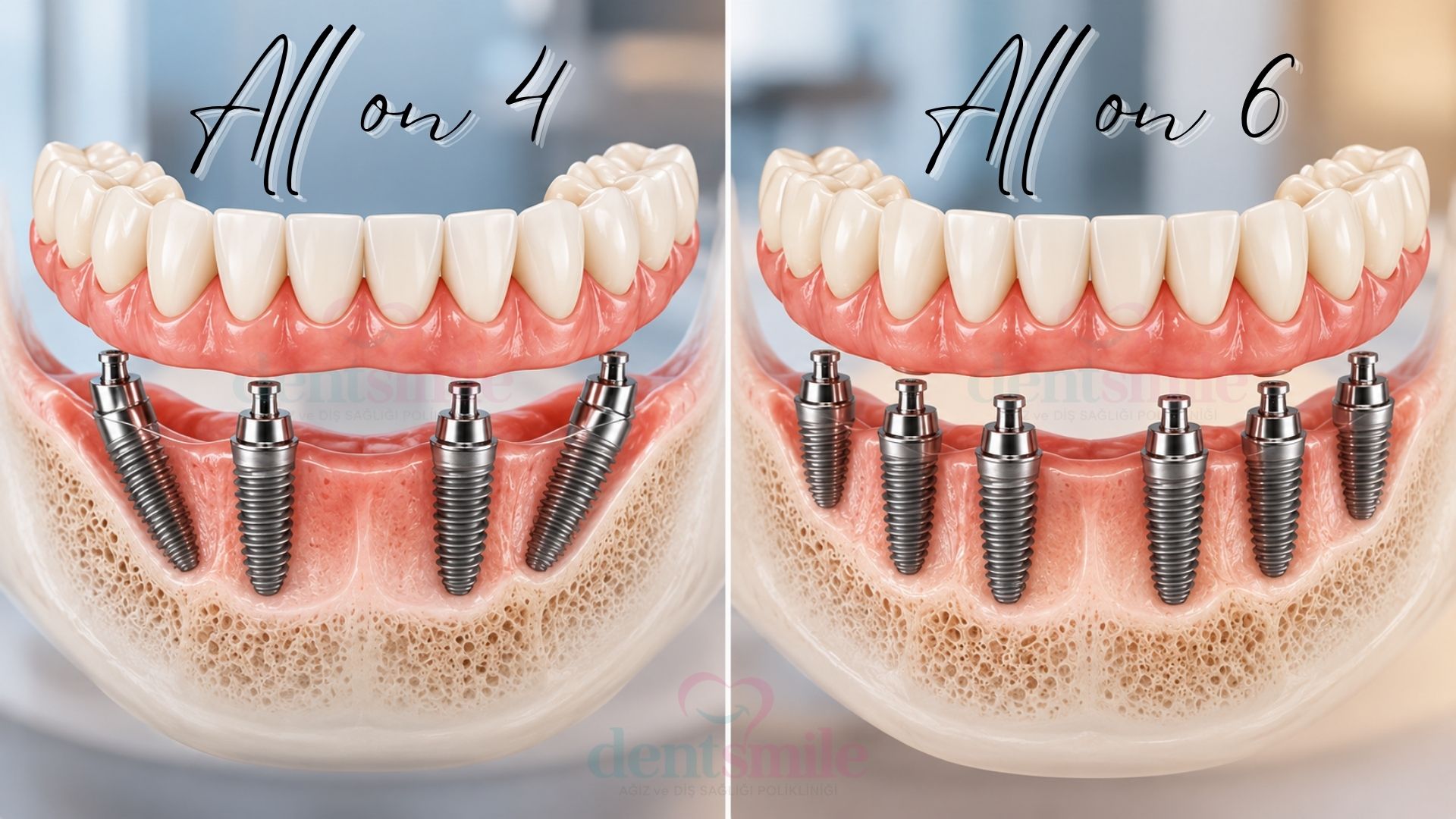
All-on-4 and All-on-6 are implant-supported treatment approaches designed to provide fixed full-arch prostheses for patients with complete tooth loss. All-on-4 uses four implants in one jaw, while All-on-6 uses six. In addition to implant numbers, these methods may differ in force distribution, bone requirements, surgical planning, and cost. The most suitable option depends on the patient's jawbone structure, oral health, and individual treatment needs.
What Are All-on-4 and All-on-6 Implant Treatments?
Removable dentures do not always provide the comfort that patients expect after losing all their teeth. Denture movement during meals, lack of confidence when speaking, and difficulty chewing may encourage patients to consider fixed alternatives. All-on-4 and All-on-6 are full-arch rehabilitation approaches developed to address these concerns.
Both techniques aim to support a fixed prosthesis for an entire jaw using a limited number of implants, rather than replacing each missing tooth with a separate implant. The goal is to restore chewing function and create an aesthetically pleasing appearance in an edentulous jaw.
The fundamental distinction is that All-on-4 uses four implants and All-on-6 uses six. However, treatment success depends on more than the number of implants. Their positions, the quality of the supporting bone, the prosthetic design, and balanced distribution of chewing forces are also important.
How Is All-on-4 Implant Treatment Performed?
All-on-4 treatment involves placing four implants to support a fixed dental prosthesis in one jaw. In the conventional All-on-4 configuration, the two anterior implants are usually positioned more vertically, while the two posterior implants may be placed at carefully planned angles.
Angling the posterior implants may allow more effective use of available bone and help avoid important anatomical structures. In the upper jaw, the maxillary sinuses must be considered, while the nerve canal is an important factor in the lower jaw.
One potential benefit of this approach is that it may reduce the need for extensive bone grafting in appropriately selected patients. Nevertheless, it would be incorrect to claim that bone grafting is never required for All-on-4 treatment. Additional procedures or a different plan may be necessary when bone volume or density is inadequate.
The four implants must be positioned appropriately and achieve sufficient stability to support the planned full-arch restoration.
How Is All-on-6 Implant Treatment Performed?
The All-on-6 approach uses six implants to support a fixed full-arch dental prosthesis. Implant positions are planned according to the individual patient's anatomy and the amount and quality of available jawbone.
Using six implants can provide additional support points for the restoration under suitable conditions. This may offer biomechanical advantages when distributing chewing forces and designing the prosthesis. However, simply increasing the number of implants does not automatically ensure ideal force distribution. Implant placement and prosthetic design are just as important.
All-on-6 requires sufficient suitable bone to accommodate six implants. Patients with inadequate bone volume may need additional bone augmentation procedures. In some situations, a four-implant treatment plan may be more appropriate for the available anatomy.
Is There a Difference in Strength Between All-on-4 and All-on-6?
One of the most common questions is whether six implants are necessarily stronger than four. Although additional implants may initially seem to provide greater strength, clinical outcomes cannot be explained by implant numbers alone.
A properly designed fixed prosthesis supported by four implants can function successfully for many years. Six-implant systems may offer useful additional support in certain cases. This can be particularly relevant when patients have bruxism, high chewing forces, or fixed teeth or restorations in the opposing jaw.
Current scientific evidence does not establish that one approach consistently achieves superior implant or prosthesis survival in every clinical situation. Therefore, it is inaccurate to say that All-on-6 is always stronger or that All-on-4 is inherently less durable.
Long-term outcomes depend on implant positioning, bone support, prosthesis quality, oral hygiene, and regular follow-up examinations.
Which Treatment Is More Suitable for Patients with Insufficient Jawbone?
Jawbone volume can decrease over time following complete tooth loss. Patients who lost their teeth many years earlier may have less bone available for implant placement. Assessing the three-dimensional anatomy of the jaw before treatment is therefore important.
In All-on-4 planning, the use of tilted posterior implants may make it possible to take advantage of existing bone in selected areas. Under certain anatomical conditions, this may reduce the need for bone grafting.
All-on-6 requires adequate bone support for six appropriately positioned implants. Additional surgical procedures may be considered if suitable bone is lacking. However, the extent and location of bone loss vary considerably between patients.
Not every patient with bone loss should receive All-on-4, and not every patient with good bone volume requires All-on-6. The preferred method is determined through clinical examination and, where indicated, imaging such as cone-beam computed tomography.
Can Fixed Teeth Be Provided on the Same Day with All-on-4 or All-on-6?
One appealing feature of these treatments is that suitable patients may receive a temporary fixed prosthesis shortly after implant placement. This approach is commonly referred to as immediate loading.
However, whether fixed teeth can be provided on the day of surgery does not depend solely on the number of implants. The initial stability achieved during placement, bone quality, distribution of implants, and temporary prosthesis design must all be evaluated.
Some patients can receive temporary fixed teeth within a short period when the necessary conditions are met. For others, waiting for the implants to integrate with the bone may be safer.
It is also important to distinguish between a temporary prosthesis fitted soon after surgery and the definitive restoration provided at the end of treatment. The timing of the final prosthesis depends on healing and the individual treatment plan.
Do All-on-4 and All-on-6 Differ in Treatment Time and Cost?
The use of four versus six implants is one of the factors affecting overall treatment cost. Additional implants may increase surgical and material expenses, but implant numbers are not the only determinant of price.
Bone grafting, extractions, temporary restorations, the material selected for the definitive prosthesis, and dental laboratory work can all influence the total cost. Therefore, All-on-4 is not necessarily the least expensive approach in every situation, and All-on-6 does not always cost substantially more.
Treatment duration also varies. Surgery, healing, and production of the final prosthesis differ from patient to patient. The overall process may be longer when bone augmentation procedures are required.
When comparing options, patients should consider not only initial expenses but also the possible costs of future maintenance, examinations, and repairs.
Which Lasts Longer: All-on-4 or All-on-6?
Implants used in either approach may continue functioning for many years. Nevertheless, no implant treatment can be guaranteed to remain completely free from complications for a lifetime.
Inflammation around implants, supporting bone loss, and mechanical complications can develop. Inadequate cleaning around implants, smoking, uncontrolled teeth grinding, and certain health conditions may influence long-term results.
Daily cleaning is important with both All-on-4 and All-on-6 restorations. Appropriate cleaning beneath the fixed prosthesis helps maintain healthy tissues around the implants. Regular professional examinations also allow the dentist to assess the condition of both the implants and the restoration.
Long-term success depends on proper patient selection, surgical and prosthetic planning, and consistent maintenance working together, rather than implant numbers alone.
All-on-4 and All-on-6 Implant Treatment in Üsküdar
At Dentsmile Oral and Dental Health Polyclinic in Üsküdar, Istanbul, treatment planning for complete tooth loss takes into account jawbone volume and quality, gum health, the condition of the opposing teeth, bite relationships, and the patient's general health.
The decision between All-on-4 and All-on-6 should not be based on the assumption that more implants necessarily produce better results. The objective is to design an aesthetic, cleanable fixed prosthesis suited to the patient's anatomy and capable of distributing chewing forces appropriately.
All-on-4 can provide successful full-arch rehabilitation with four implants in suitable patients, while All-on-6 may offer additional support points in certain clinical circumstances. The best approach is established after a thorough examination and individualized treatment planning.