
Q&A
When Is Baby Tooth Extraction Necessary in Children?
When should a child have a baby tooth extracted? Learn about decay, abscesses, dental trauma, early tooth loss and space maintainers.
 Answered by:
Uzman Dr. Dt. Yağmur Yıldırım
Published:
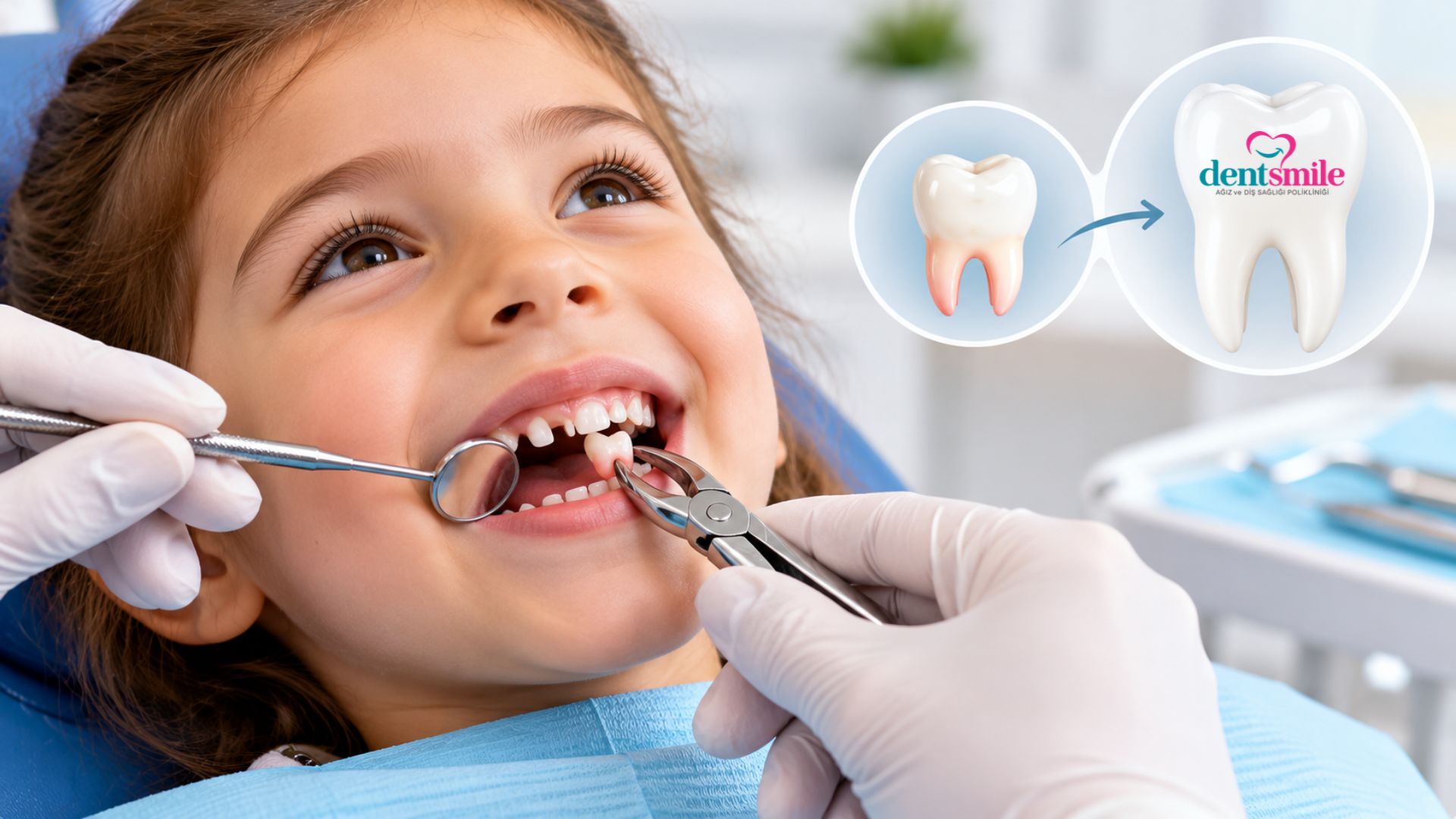
Baby tooth extraction may be necessary in children in cases of severe tooth decay, infections that cannot be treated, significant dental trauma, excessive root resorption, or when a primary tooth prevents a permanent tooth from erupting. However, baby teeth play an important role in the healthy development and correct positioning of permanent teeth. Before deciding on extraction, the dentist should assess whether the tooth can be preserved with a filling, pulp treatment, or another method. Some children may require a space maintainer following premature loss of a primary tooth.
When Is Baby Tooth Extraction Necessary in Children?
The natural shedding of baby teeth at the appropriate age is a normal part of dental development. However, some primary teeth may become severely decayed, infected, or damaged by trauma before they are due to fall out. In such situations, parents often wonder whether the tooth should be treated or extracted.
The fact that baby teeth will eventually be replaced does not mean that losing them prematurely is unimportant. Primary teeth support nutrition, chewing, and speech development. They also help preserve the space needed for the permanent teeth developing beneath them to erupt in the correct positions.
Extraction of a baby tooth is considered when the tooth cannot be preserved in a healthy condition or when it negatively affects oral health. However, not every decayed, painful, or loose primary tooth needs to be removed. The possibility of treating and preserving the tooth should be evaluated first.
Should Severely Decayed Baby Teeth Be Extracted?
Primary teeth can develop cavities just like permanent teeth. When decay is not identified early, substantial loss of tooth structure may occur. If the decay reaches the pulp tissue inside the tooth, the child may experience pain, sensitivity, or infection.
However, severe decay does not automatically mean that extraction is necessary. If sufficient healthy tooth structure remains, the tooth may be preserved with a filling, pulp treatment, or a suitable restoration.
Extraction may be considered when a large portion of the tooth has been destroyed, there is not enough healthy structure to support a restoration, or the likelihood of successful treatment is very low.
The decision depends not only on the extent of decay but also on how long the primary tooth is expected to remain in the mouth and the developmental stage of its permanent successor.
Is Extraction Necessary if a Baby Tooth Has an Infection or Abscess?
Advanced decay in a baby tooth may lead to infection of the tissue inside it. In some children, the infection causes gum swelling, an abscess, pain, or an unpleasant taste in the mouth.
When treating an infected primary tooth, the first step is to determine whether it can be preserved. In selected cases, appropriate pulp therapy or root canal treatment may allow the tooth to remain in place.
However, extraction may be more appropriate if the infection cannot be controlled, the roots show advanced pathological resorption, or the surrounding tissues have suffered considerable damage.
An infected baby tooth should not be neglected while waiting for it to fall out naturally. Facial swelling, fever, or deterioration in the child's general condition requires prompt dental assessment. Difficulty swallowing or breathing requires emergency medical evaluation.
Should Baby Teeth Broken by Trauma Be Extracted?
Children may injure their primary teeth when falling, bumping into objects, or having accidents during play. The front baby teeth are particularly susceptible to fractures, displacement, or being completely knocked out.
Not every injured primary tooth needs to be extracted. Minor fractures may be repaired, and some displaced teeth can be monitored. However, extraction may become necessary if the tooth is severely displaced, damages the surrounding tissues, or is too badly injured to preserve.
The developing permanent tooth beneath the injured primary tooth must also be considered during treatment planning. The aim is not only to manage the damaged baby tooth but also to reduce potential risks to permanent tooth development.
Unlike an avulsed permanent tooth, a completely knocked-out baby tooth must not be replanted into its socket. The child should be evaluated by a dentist without delay.
Should a Baby Tooth Be Extracted if It Does Not Fall Out When the Permanent Tooth Erupts?
In some children, a permanent tooth begins to erupt while the baby tooth above it remains in place. This is particularly common around the lower front teeth, where parents may notice what appears to be a second row of teeth.
This situation does not always require immediate extraction. Some baby teeth eventually fall out naturally, while the permanent teeth may move toward a more suitable position under the influence of the tongue and lip muscles.
However, extraction may be considered if the baby tooth remains for an extended period, interferes with the eruption of the permanent tooth, or causes a significant problem with tooth alignment.
The dentist examines the mobility of the primary tooth, the position of the permanent tooth, and the condition of the roots before deciding whether extraction is necessary.
Can Early Extraction of a Baby Tooth Affect Permanent Teeth?
One of the important functions of primary teeth is helping preserve the space needed for the permanent teeth to erupt. Premature loss of primary molars, in particular, may allow neighboring teeth to shift toward the empty space.
As a result, the space reserved for a permanent tooth may become narrower. This can increase the likelihood of crowded teeth or eruption difficulties in later years.
However, not every prematurely lost baby tooth causes space loss. The risk depends on which tooth has been lost, the child's stage of dental development, the position of the permanent successor, and the existing bite relationship.
Therefore, when early extraction is being considered, the dentist should assess not only the condition of the affected tooth but also the possible consequences for the future alignment of the permanent teeth.
Is a Space Maintainer Necessary After Baby Tooth Extraction?
A space maintainer is an appliance used to help preserve the gap left when a primary tooth is lost prematurely. It may be particularly useful after the early loss of certain baby molars when a long time remains before the permanent successor is expected to erupt.
However, a space maintainer is not automatically required after every primary tooth extraction. The decision depends on the position of the missing tooth, the expected time until the permanent tooth erupts, and the available space in the child's mouth.
Space maintainers can be fixed or removable. If one is recommended, regular checkups and appropriate cleaning are essential. These appliances may become loose, break, or accumulate plaque if they are not maintained correctly.
Assessing the potential need for a space maintainer before extraction helps the dentist plan for the child's future dental development.
Is It Better to Treat a Baby Tooth Rather Than Extract It?
The general principle in pediatric dentistry is to preserve primary teeth until their natural shedding time whenever reasonably possible. Depending on the condition of the tooth, restorative options such as fillings, pulp treatment, or crowns may be considered.
Nevertheless, it is not always possible to save a damaged primary tooth. Extraction may be necessary to protect the child's oral health when extensive loss of tooth structure, an infection that cannot be controlled with treatment, or serious root damage is present.
Therefore, neither attempting to retain every baby tooth under all circumstances nor immediately extracting every problematic tooth is an appropriate approach. The best decision comes from evaluating both the tooth's treatability and the child's overall dental development.
Baby Tooth Extraction in Children in Üsküdar
At Dentsmile Oral and Dental Health Polyclinic in Üsküdar, Istanbul, the assessment of baby tooth extraction in children takes into account the extent of decay, the presence of infection, the structure of the tooth roots, and the developmental stage of the permanent teeth.
An important part of planning dental treatment for children is communicating in a manner suited to their age and emotional needs. When extraction is necessary, the aim is to explain the procedure in language the child can understand and perform it using appropriate pain-control methods.
If a baby tooth is lost prematurely, the eruption of the permanent teeth is evaluated, and a space maintainer or follow-up schedule may be planned if necessary.
Early extraction of a primary tooth is not always the right solution. However, retaining a tooth that cannot be preserved may also lead to infection and other problems. The most suitable decision should be made after a detailed assessment of the child's oral and dental development.