
Blog
Dental Crowns and Crown Technologies in Modern Dentistry
Explore modern dental crowns, zirconia and ceramic restorations, CAD/CAM and CEREC technologies, and advances in digital dental crown treatments.
Published:
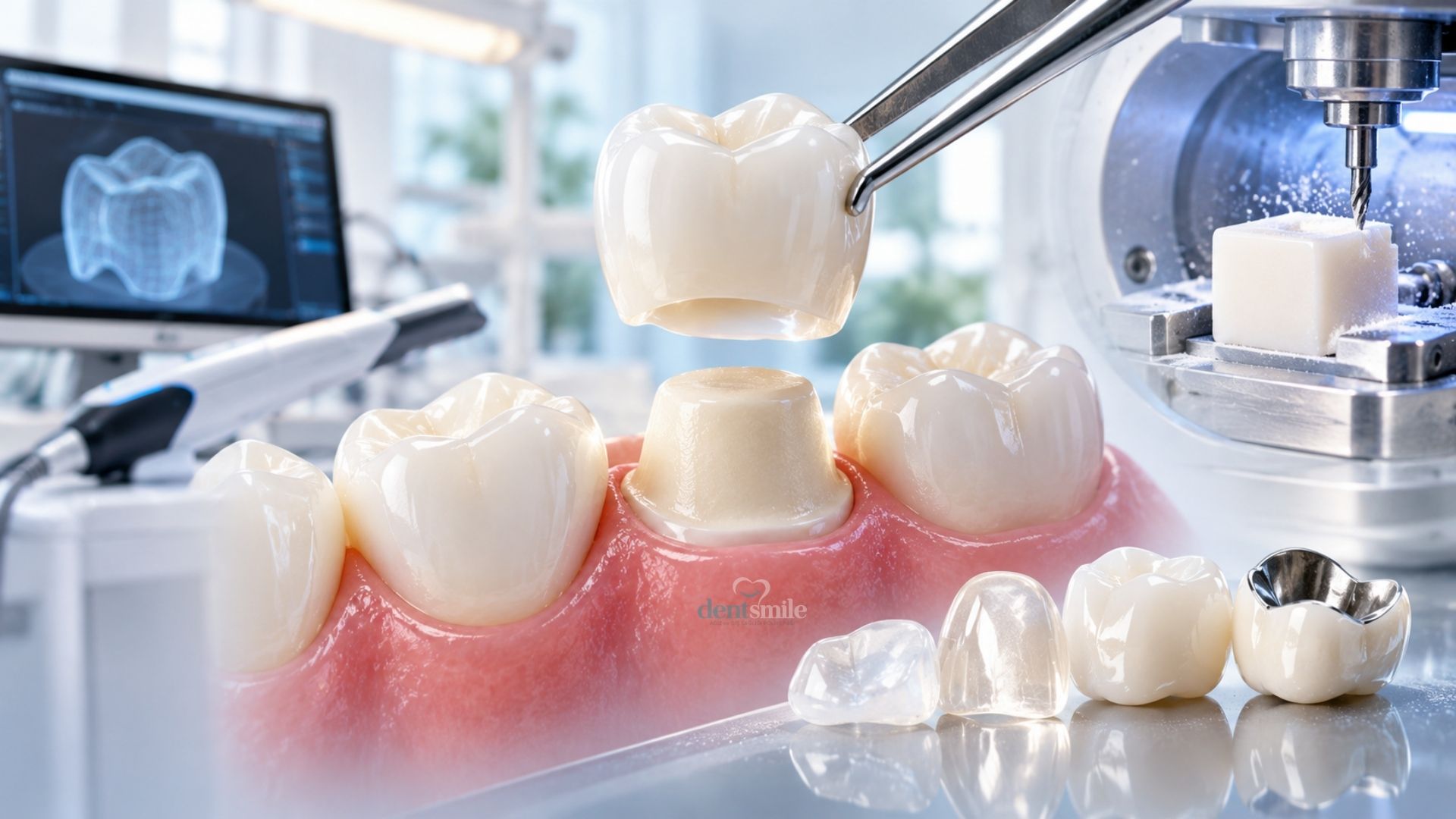
In modern dentistry, dental crowns are used to restore the aesthetic appearance and chewing function of damaged teeth. Zirconia, glass ceramics, and digital CAD/CAM technologies offer personalized restorative treatment options that focus on preserving natural tooth structure.
Advances in dental materials and digital manufacturing systems have significantly transformed dental crown treatments in recent years. While porcelain-fused-to-metal restorations were traditionally used in many clinical situations, a wider range of all-ceramic materials is now available.
Dental crowns are not used solely to improve the appearance of teeth. Protecting teeth that have been structurally weakened by decay, fractures, wear, or extensive loss of tooth structure, as well as restoring their chewing function, are also among the primary objectives of treatment.
In modern restorative dentistry, the strength or appearance of the crown material is not the only consideration. Preserving as much healthy tooth structure as possible, ensuring compatibility with surrounding tissues, and maintaining long-term function are fundamental principles of treatment planning.
The Role of Dental Crowns in Modern Restorative Dentistry
A dental crown is a restoration designed to cover part or all of the visible portion of a natural tooth to restore its shape and function.
Crowns are generally considered when a tooth has lost a significant amount of structure, when the remaining tissues cannot be adequately protected with a direct filling, or when a more extensive restoration is necessary.
Crown treatment may be appropriate for extensive decay, tooth fractures, severe wear, and certain root canal-treated teeth. Crowns are also used in suitable cases as part of implant-supported restorations.
However, not every damaged tooth requires a crown. Depending on the extent of tooth structure loss and the condition of the remaining healthy tissues, composite fillings, inlays, onlays, or other restorative methods may be more appropriate.
Therefore, the fundamental approach to dental crown treatment today is not to place crowns on every tooth, but to select the appropriate restoration for teeth that genuinely require them.
From Traditional Crowns to Modern Ceramic Restorations
The materials used to manufacture dental crowns have undergone significant development over time.
Porcelain-fused-to-metal crowns have been used in dentistry for many years. In these restorations, porcelain is applied over a metal framework to combine mechanical strength with an aesthetic appearance.
However, in certain clinical situations, the metal framework may limit light transmission and affect the natural appearance of the tooth.
Modern all-ceramic systems can be manufactured without a metal framework. Zirconium dioxide and lithium disilicate-based ceramics are among the materials commonly used in this field.
Nevertheless, a newer material does not necessarily provide better results in every situation. Different materials have distinct mechanical properties, aesthetic characteristics, preparation requirements, and clinical indications.
Successful treatment therefore requires selecting the material according to the patient's individual clinical needs.
Aesthetic and Functional Properties of Zirconia Crowns
Zirconia dental crowns are restorations manufactured from zirconium dioxide-based ceramic materials. Due to their mechanical strength and range of aesthetic properties, they can be used for both anterior and posterior teeth.
Not all zirconia materials are identical. Modern zirconia systems are available with different levels of strength and translucency.
Certain zirconia materials with greater translucency may help create a more natural appearance in anterior restorations when clinical conditions are suitable. However, increasing translucency may also be associated with changes in certain mechanical properties.
For this reason, the zirconia selected for front teeth does not necessarily need to have the same characteristics as the material used for posterior teeth exposed to higher chewing forces.
Zirconia crowns can be manufactured as monolithic restorations, meaning they are made from a single piece of material. They may also be layered with porcelain when specific aesthetic requirements make this appropriate.
The choice of technique depends on tooth position, aesthetic expectations, bite relationships, and other clinical conditions.
Glass-Ceramic Crowns and Natural Tooth Aesthetics
Glass ceramics represent another important group of materials used in modern aesthetic dentistry.
Lithium disilicate-based ceramics, in particular, may be preferred for suitable anterior restorations because of their translucency and aesthetic characteristics.
These materials can make it possible to create restorations that closely resemble the optical properties of natural teeth. However, the final appearance does not depend solely on the ceramic material.
The existing tooth shade, ceramic thickness, surface characteristics, bonding materials, and appearance of neighboring teeth all influence the aesthetic result.
Glass ceramics may be used in certain crowns, inlays, onlays, and veneer restorations. However, the same material is not necessarily suitable for every patient or every tooth.
Material selection requires particular care in patients with high chewing forces, extensive restorations, or specific bite problems.
CAD/CAM Technology and Digital Dental Crown Manufacturing
Digital technology has significantly changed the way dental crowns are designed and manufactured.
CAD/CAM stands for Computer-Aided Design and Computer-Aided Manufacturing. This technology allows dental restorations to be designed digitally and produced using suitable manufacturing systems.
In traditional workflows, impressions are generally taken using physical impression materials. In digital workflows, intraoral scanners can be used instead.
The three-dimensional data obtained through intraoral scanning is used to design the restoration. The crown can then be manufactured by milling an appropriate ceramic block or through other production methods, depending on the system.
Digital systems support impression-taking and restoration design while potentially providing a more comfortable experience for certain patients.
However, using digital impressions or computer-aided manufacturing does not automatically guarantee a perfectly fitting restoration.
Accurate tooth preparation, impression quality, material selection, manufacturing procedures, and clinical verification remain essential for successful results.
CEREC Technology and Same-Day Dental Crowns
One of the systems used in digital restorative dentistry is CEREC technology.
CEREC is a CAD/CAM system that enables suitable restorations to be digitally designed and, depending on the clinical workflow, manufactured on the same day.
In certain cases, inlays, onlays, and dental crowns can be completed during a single appointment.
Traditional methods may require multiple visits because of laboratory procedures. When appropriate chairside digital manufacturing equipment is available, the total number of appointments can sometimes be reduced.
However, not every dental crown treatment can be completed in one appointment.
The condition of the tooth, the type of restoration, the necessary preparation procedures, and other clinical factors determine the treatment duration.
The main advantage of digital technology is not simply speed. Its potential contributions to treatment planning, restoration design, and patient comfort should also be considered.
Preserving Natural Tooth Structure During Crown Treatment
In modern dentistry, the minimally invasive approach focuses on preserving as much healthy natural tooth structure as possible.
When preparing a tooth for a crown, a certain amount of tooth structure may need to be removed to create sufficient space for the selected restoration.
This preparation is necessary to ensure adequate material thickness and proper placement of the crown.
However, removing more tooth structure than necessary may compromise the structural integrity of the natural tooth.
Therefore, the existing tooth condition, the restorative material, and the amount of preparation required should all be evaluated together.
For patients with only minor aesthetic concerns and largely healthy teeth, more conservative treatments should be considered before full crowns.
Composite bonding, porcelain veneers, inlays, and onlays may help preserve more natural tooth structure in suitable cases.
The Relationship Between Dental Crowns and Gum Health
One of the important factors in the long-term success of dental crown treatment is gum health.
Regardless of how aesthetic or durable a crown may be, problems can develop if the restoration is not compatible with the surrounding gum tissues.
The fit of the crown margins, their relationship with the gums, and the ability to clean the surrounding areas effectively are particularly important.
Poorly fitting crown margins or areas that are difficult to clean can encourage bacterial plaque accumulation. Over time, this may contribute to gum inflammation and problems affecting the tissues surrounding the restoration.
For this reason, existing gum disease should be evaluated and treated when necessary before crown placement.
Following treatment, regular toothbrushing, interdental cleaning, and appropriate oral hygiene practices should be maintained.
Aesthetic Appearance and Bite Balance in Dental Crowns
Successful dental crowns must provide both a natural appearance and appropriate functional performance.
For front teeth, tooth color, shape, size, translucency, and relationship with facial features are important aspects of aesthetic planning.
For back teeth, the ability to withstand chewing forces and maintain proper contact with opposing teeth becomes particularly important.
However, this does not mean that function is less important for front teeth or that aesthetics are irrelevant for back teeth.
Both elements should be considered in every restoration.
In patients who clench or grind their teeth, excessive bite forces may influence the long-term performance of dental crowns.
Therefore, selecting a strong material alone is not sufficient. When necessary, teeth grinding habits should be assessed, and additional protective measures may be considered.
Dental Crowns for Root Canal-Treated Teeth
The choice of restoration for a root canal-treated tooth depends on the amount of remaining healthy tooth structure and the tooth's function within the mouth.
Not every tooth that has undergone root canal treatment requires a crown.
However, particularly in posterior teeth with extensive structural damage, restorations providing cuspal coverage or full crowns may be considered to protect the remaining tooth structure.
The purpose of placing a crown is not simply to cover the tooth externally, but to support its structural integrity and function.
The amount of healthy tooth structure remaining, the presence of cracks, the condition of existing restorations, and chewing forces are important factors in treatment planning.
Factors Affecting the Longevity of Dental Crowns
The lifespan of dental crowns varies from patient to patient. The long-term performance of a restoration cannot be explained solely by the strength of the ceramic material used.
Treatment planning, the condition of the natural tooth, marginal fit, bonding or cementation technique, and the patient's oral hygiene habits may all affect the outcome.
The health of the natural tooth structure beneath the crown is particularly important.
A tooth restored with a crown is not completely protected against dental decay. New cavities may develop in the natural tooth structure near the crown margins if bacterial plaque is not adequately controlled.
Gum disease, excessive chewing forces, and neglected dental check-ups may also affect the long-term health of restorations.
For this reason, consistent oral hygiene and individually scheduled dental examinations remain important after crown treatment.
Modern Dental Crown Technologies in Turkey
Digital systems and modern restorative materials used in dentistry in Turkey allow a range of treatment options to be considered at clinics with suitable equipment and clinical expertise.
Zirconia, lithium disilicate-based ceramics, intraoral scanners, and CAD/CAM manufacturing systems are among the important components of contemporary restorative dentistry.
However, access to modern technology alone does not guarantee successful treatment.
Clinical examination, accurate diagnosis, appropriate treatment indications, knowledge of restorative materials, careful restoration planning, and evaluation of the patient's long-term needs are equally important.
Whether traditional or digital techniques are used, the primary goal should be to create restorations that preserve the health of natural teeth while providing appropriate function and aesthetics.
Digital Dental Crowns and Restorative Dentistry in Üsküdar, Istanbul
At Dentsmile Oral and Dental Health Polyclinic in Üsküdar, Istanbul, dental crown treatments are planned by evaluating the patient's existing tooth structure, remaining healthy tissues, aesthetic expectations, and chewing function.
Personalized treatment options may include zirconia crowns, ceramic restorations, and digital CAD/CAM technologies when clinically appropriate.
The primary objective is not simply to change the external appearance of the teeth, but to establish aesthetic and functional harmony while preserving as much natural tooth structure as possible.
Following the necessary clinical examinations, the type of restoration, selected material, and treatment process are determined according to the patient's individual requirements.
The Future of Dental Crown Technologies: More Conservative and Personalized Treatments
Crown and restoration technologies in modern dentistry continue to develop through advances in material science and digital manufacturing methods.
The introduction of ceramic materials with different optical and mechanical properties, the increasing use of intraoral scanning systems, and improved digital design capabilities provide more treatment options in restorative dentistry.
However, the most important development in the future of dental care is not simply producing faster or more aesthetic crowns.
Preserving natural tooth structure, avoiding unnecessary interventions, and maintaining the long-term biological compatibility of restorations with surrounding tissues remain fundamental principles of modern restorative dentistry.
A successful dental crown treatment is therefore more than a restoration that looks attractive. It is a comprehensive approach intended to protect the health, chewing function, and surrounding tissues of the natural tooth.